What are Microsoft Copilot PCs and how are they different from traditional PCs?
Microsoft Copilot PCs are a new class of Windows devices designed specifically to handle AI workloads on the device itself.
Instead of relying only on a CPU and GPU like traditional PCs, Copilot PCs add a dedicated neural processing unit (NPU). The NPU is optimized for AI tasks such as:
- Natural language processing
- Image and video enhancement
- Context-aware task automation
This hardware foundation enables new Windows capabilities, including:
- Recall (preview) with IT controls, to quickly resurface past work and activity
- Click to Do (preview), for one-click automations of routine tasks
- Windows Studio Effects, for improved audio and video in meetings
- Live Captions with real-time translation, to support multilingual and accessible collaboration
For organizations, the practical differences versus legacy devices include:
- Faster, more responsive performance for everyday work
- Longer unplugged run times (interviewees reported moving from around 4 hours to about 16 hours in some cases)
- On-device AI that supports search, content creation, and automation without always depending on the cloud
- Built-in security features such as Microsoft Pluton security processors and virtualization-based safeguards
In short, Copilot PCs are built to reimagine the PC as an AI-ready endpoint that supports modern workloads, rather than a general-purpose device that struggles with emerging AI use cases.
What business value and ROI can we expect from Copilot PCs?
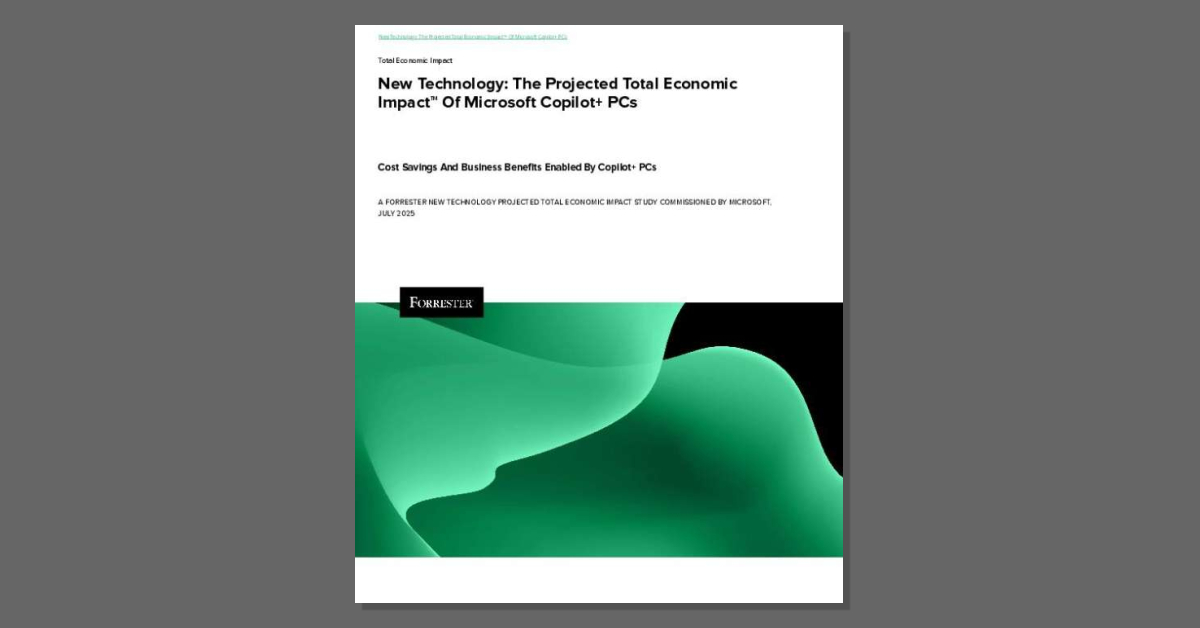
A Forrester Consulting Total Economic Impact (TEI) study, commissioned by Microsoft, modeled the projected financial impact of Copilot PCs for a composite global organization with:
- 2,000 employees
- $1 billion in annual revenue
- 1,600 Windows PC users
Based on interviews with nine decision-makers already using Copilot PCs, Forrester projected the following three-year, risk-adjusted outcomes:
1) Overall financial impact
- Projected high-impact scenario: Net present value (NPV) of about $7.7M and ROI of 367%
- Projected medium-impact scenario: NPV of about $5.7M and ROI of 271%
- Projected low-impact scenario: NPV of about $2.9M and ROI of 137%
2) Quantified benefit areas (three-year projected present value)
- Amplified end-user efficiency: $4.9M to $9.6M
- Efficiency improvements across the workforce in the 6% to 13% range
- Power users gaining 1.5 to 5 hours per week over time through Recall, improved search, Click to Do, and local AI agents
- Improved IT operations (ITOps) efficiency: $53K to $92K
- 20% to 30% time savings on ongoing device management
- 10% to 50% reduction in help desk effort for device-related issues
- Reduced risk of security breach exposure: $22K to $66K
- Driven by Pluton security processors, virtualization-based protections, and AI-supported threat detection at the chip level
3) Cost profile (three-year projected present value)
- Copilot PC devices: 1,600 devices at an average of $1,320 each, for a PV of about $2.025M
- Planning and provisioning: ITOps effort with a PV of about $70K
Beyond the quantified benefits, interviewees also highlighted unquantified gains such as:
- Better employee experience from faster, more reliable, AI-enabled devices
- Enhanced customer outcomes due to AI-accelerated analytics and content work
- Improved meeting quality and global collaboration via Windows Studio Effects and Live Captions with real-time translation
- Better alignment with sustainability goals through more power-efficient devices and longer battery life
For organizations evaluating Copilot PCs, these projections provide a structured way to estimate potential ROI and understand where the value is most likely to show up: employee productivity, IT efficiency, and reduced security risk.
How do Copilot PCs impact employees, IT teams, and security in day-to-day operations?
The study highlights three main operational impact areas: end users, IT operations, and security.
1) Impact on employees (end users)
Before Copilot PCs, organizations reported:
- Slower devices with diminishing performance and battery life
- Manual search and repetitive tasks (finding files, rebuilding documents, switching apps)
- Frequent context switching and delays in project work
After deploying Copilot PCs, interviewees observed:
- Noticeably faster device responsiveness and app launches
- Several additional hours of battery life, with some benchmarks moving from about 4 hours to around 16 hours
- Easier, more contextual search across documents, emails, and files
- Time savings from Recall (preview), Click to Do (preview), and integrated AI assistance in Windows workflows
Forrester modeled:
- Power users (about 10% of Windows users) gaining 1.5 to 2.5 hours per week initially, increasing up to 2.5 to 5 hours per week by Year 3
- General users gaining 1 to 2 hours per week initially, increasing up to 1.5 to 3 hours per week by Year 3
- 50% of this time being redirected to higher-value work
2) Impact on IT operations
Previously, IT teams dealt with:
- High volumes of routine support tickets (e.g., camera issues, VPN drops, driver updates)
- Time-consuming device setup and imaging
- Fragmented AI pilots running on aging hardware
With Copilot PCs, interviewees reported:
- Fewer routine help desk tickets, with some expecting a 25% to 50% reduction in device-related requests over time
- Faster provisioning and setup (e.g., new users going from 45–60 minutes to about 15 minutes to be fully ready)
- More stable devices and self-service capabilities that reduce the need for IT intervention
Forrester’s model assumes:
- Four device support FTEs, each spending 25% of their time on device management
- 20% to 30% reduction in time spent on ongoing device management
- 10% to 50% decline in OS/hardware-related help desk requests as deployment matures
This allows IT staff to shift more time toward strategic initiatives instead of repetitive support work.
3) Impact on security
Legacy devices left organizations more exposed due to:
- Older hardware without modern, chip-level protections
- Limited ability to use AI for threat detection at the endpoint
Copilot PCs introduce:
- Microsoft Pluton security processors built into the device
- Virtualization-based safeguards to isolate sensitive processes
- Support for AI-driven threat detection at the chip level, helping to contain addressable attacks more quickly
Forrester projects the reduced risk of a security breach exposure to be worth a three-year PV of $22K to $66K for the composite organization.
Taken together, these changes help organizations rethink how endpoints support productivity, IT efficiency, and security—moving from reactive support on aging hardware to a more proactive, AI-enabled device strategy.




 Sign in with LinkedIn